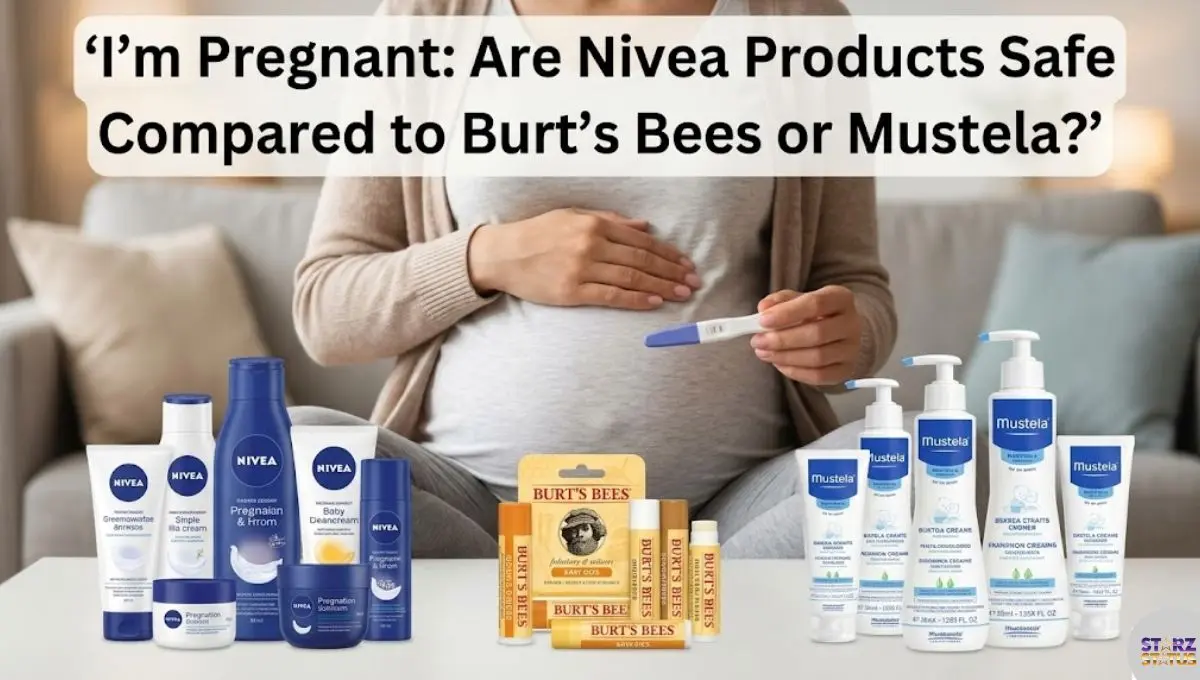
If you’re asking, “I’m a pregnant woman: Are Nivea Products Safe Compared to Burt’s Bees or Mustela?” the safest answer is: it depends on the exact product formula, not the brand name. Many basic moisturizers from Nivea, Burt’s Bees, and Mustela can fit a pregnancy skincare routine, but labels matter more than marketing.
During pregnancy, your skin may become drier, itchier, more reactive, or more prone to pigmentation. A gentle moisturizer may help with comfort, but products containing retinoids, hydroquinone, high-strength exfoliating acids, strong fragrances, or certain essential oils warrant extra caution.
Dermatology guidance recommends reading ingredient labels and discussing prescription or active skincare with a healthcare provider during pregnancy.
Which Brand Is Safer During Pregnancy?
No single brand is universally safest during pregnancy.
Nivea is often a good option for affordable everyday hydration, especially when you choose simple fragrance-free body lotions.
Burt’s Bees may appeal to people who prefer natural-positioned skincare, but “natural” does not automatically mean pregnancy-safe.
Mustela has the strongest pregnancy and maternity positioning, especially for stretch-mark body care, but even Mustela products should still be checked by their ingredient lists.
A practical answer is:
| Need | Better Starting Point |
| Basic dry skin hydration | Nivea or Burt’s Bees |
| Pregnancy belly care | Mustela or Burt’s Bees Mama line |
| Sensitive skin pregnancy | Fragrance-free options from any brand |
| Stretch mark support | Mustela maternity products or Burt’s Bees Belly Butter |
| Ingredient confidence | Product-by-product label review |
Why Pregnancy Skincare Safety Is Different
Pregnancy skincare is different because your body is not in its usual hormonal state. Skin that tolerated scented lotions, strong acne products, or exfoliating serums before pregnancy may suddenly sting, itch, or flare.
This does not mean skincare while pregnant has to be complicated. In most cases, a simple pregnancy skincare routine built around cleansing, moisturizing, sunscreen, and skin barrier protection is enough.
Hormonal Skin Changes During Pregnancy
Hormonal skin changes during pregnancy can affect oil production, pigmentation, blood flow, collagen behavior, and skin sensitivity.
Some pregnant women notice a healthy glow. Others experience acne, dryness, melasma, redness, itching, or new sensitivity. These changes are common, but the right product choice depends on the symptom.
Increased Sensitivity and Irritation
Sensitive skin pregnancy concerns are common because the skin barrier may feel less tolerant.
A lotion that once felt luxurious may now feel too perfumed. A “natural” balm may contain botanical oils that trigger irritation. A product labeled “dermatologist tested” may still include fragrance or active ingredients that do not suit your current skin.
Dryness, Tightness, and Stretch Marks
Pregnancy skin hydration matters because the abdomen, breasts, hips, and thighs stretch as the body changes.
Moisturizers cannot guarantee stretch mark prevention because genetics, skin structure, weight change, and pregnancy-related stretching all play roles. However, a pregnancy-safe lotion or stretch mark prevention cream may reduce dryness, tightness, and itching by supporting moisture retention.
Pigmentation, Melasma, and Uneven Skin Tone
Pregnancy can trigger melasma, sometimes called the “mask of pregnancy.” This usually appears as brown or gray-brown patches, often on the face.
The key point is to avoid harsh whitening treatments without medical advice. Hydroquinone and strong skin-lightening ingredients should not be used casually during pregnancy; dermatology guidance lists hydroquinone among ingredients to avoid while pregnant.
Also Read: I am a college student. Are La Roche-Posay products better for acne-prone skin than Neutrogena?
Nivea vs Burt’s Bees vs Mustela: Brand Safety Overview
| Brand | Main Focus | Pregnancy Focus | Natural Ingredients | Sensitive Skin Suitability | Hydration Quality | Stretch Mark Support | Best Use Case |
| Nivea | Every day face and body hydration | Limited | Limited to moderate | Product-dependent | Good to strong | Limited | Affordable daily moisturizing |
| Burt’s Bees | Natural-positioned skincare and body care | Limited to moderate | Strong | Product-dependent | Good | Good in Mama Belly Butter | Natural-style body care |
| Mustela | Baby, maternity, and sensitive skin care | Strong | Moderate to strong | Often suitable, but product-dependent | Good to strong | Strong maternity focus | Pregnancy-specific body care |
Nivea: Affordable Everyday Hydration, But Product Range Matters
Nivea can be a reasonable choice if you want basic moisturizing. Some Nivea body lotions focus on glycerin, panthenol, vitamin E, and barrier-supporting hydration. For example, Nivea’s Repair & Care Fragrance-Free Body Lotion is marketed for dry, sensitive skin and includes glycerin, panthenol, tocopherol, and niacinamide in its ingredient list.
However, the product range matters. A simple fragrance-free body lotion is very different from an anti-aging face product, brightening serum, or heavily fragranced cream.
Burt’s Bees: Natural-Looking Formulas, But Natural Does Not Always Mean Pregnancy-Safe
Burt’s Bees is popular among people looking for natural-style skincare. Its Mama Bee Belly Butter is marketed as a 99% natural-origin, fragrance-free product for stretching skin during and after pregnancy, with ingredients such as sunflower oil, glycerin, coconut oil, shea butter, jojoba butter, cocoa butter, and vitamin E.
That said, natural-positioned formulas still require label checking. Essential oils, fragrance compounds, plant extracts, and allergens can irritate sensitive pregnancy skin.
Mustela: Pregnancy and Baby-Focused, But Still Check the Label
Mustela is often the easiest starting point for pregnant women because it offers maternity-specific products. Its fragrance-free stretch marks cream is marketed for pregnancy and postpartum body care, tested under dermatological and gynecological control, and formulated to support skin comfort.
Still, “maternity” does not remove the need to check ingredients, especially if you have allergies, eczema, severe itching, or a history of fragrance sensitivity.
Why Brand Comparisons Can Be Misleading
One Brand Can Have Both Simple and Strong Products
A brand may sell a gentle moisturizer, a scented body oil, an exfoliating serum, an anti-aging cream, and a brightening product.
Those products do not have the same pregnancy safety profile.
For example, a basic Nivea fragrance-free lotion may be appropriate for dry skin. A different skincare product from the same brand with retinol or strong exfoliating ingredients would require caution.
“Natural,” “Dermatologist-Tested,” and “Baby-Safe” Do Not Mean Pregnancy-Safe
“Natural” can describe ingredient origin, but it does not automatically prove safety for sensitive skin or pregnancy concerns.
The FDA notes that cosmetic companies are responsible for product safety, and cosmetic products generally do not need FDA approval before going to market. Fragrance ingredients also do not require FDA preapproval before use in cosmetics.
Therefore, pregnancy-safe skincare products should be selected by formula, not front-label claims alone.
The Ingredient List Matters More Than the Brand Name
Real-world example:
You are comparing three body lotions.
One is Nivea, one is Burt’s Bees, and one is Mustela. The safest option may be the one that is fragrance-free, free from retinoids, free from hydroquinone, low in irritating essential oils, and rich in barrier-supporting moisturizers.
The brand helps you narrow options. The ingredient list makes the decision.
Nivea Products During Pregnancy: What to Check
Common Nivea Product Types
Nivea products may include:
- Body lotions
- Body creams
- Face moisturizers
- Hand creams
- Lip balms
- Sunscreen products
- Anti-aging creams
- Brightening or tone-evening products
- Men’s grooming products
Ingredients Usually Used for Moisturizing
Many basic moisturizers use ingredients such as:
- Glycerin
- Panthenol
- Mineral oil
- Petrolatum
- Dimethicone
- Fatty alcohols
- Shea butter
- Vitamin E
- Niacinamide
- Ceramides, depending on the formula
These ingredients are commonly used to support pregnancy skin hydration and skin barrier protection.
When Nivea May Be a Good Choice
Nivea may be a good choice during pregnancy when:
- You want affordable daily hydration.
- Your skin feels dry, tight, or itchy.
- You choose a simple body lotion rather than a strong active treatment.
- You prefer fragrance-free or sensitive-skin formulas.
- You are not treating acne, melasma, or rashes without medical guidance.
When to Be Careful With Nivea Products
Be more careful with Nivea or any brand if the product is:
- Anti-aging with retinol or retinoid-like claims
- Brightening or whitening with strong pigment-correcting ingredients
- Strongly fragranced
- Exfoliating or peeling
- Used on broken, irritated, or inflamed skin
- Causing burning, redness, itching, or rash
Burt’s Bees Products During Pregnancy: What to Check
Common Burt’s Bees Product Types
Burt’s Bees commonly offers:
- Lip balms
- Body lotions
- Belly butters
- Hand creams
- Cleansers
- Facial oils
- Baby care products
- Natural-positioned skincare products
Benefits for Dry and Sensitive Skin
Burt’s Bees may work well for dry pregnancy skin when formulas rely on emollients such as shea butter, cocoa butter, jojoba, coconut oil, sunflower oil, and glycerin.
Its Mama Bee Belly Butter is specifically positioned for stretching skin and is fragrance-free, which makes it a better starting point than a heavily scented body butter.
Essential Oils, Fragrance, and Allergy Concerns
Natural skincare often uses plant oils, extracts, or essential oils.
For many people, these are fine. For others, especially during pregnancy, they may trigger stinging, redness, or allergic contact dermatitis. The American Academy of Dermatology advises discussing certain ingredients with a dermatologist and specifically lists some essential oils among ingredients to use sparingly during pregnancy.
When Burt’s Bees May Not Be the Best Option
| Pros | Cons |
| Natural-positioned formulas | Natural does not always mean less irritating |
| Good options for dry skin | Some products may contain fragrance or botanical allergens |
| Mama Belly Butter is fragrance-free | Not every product is pregnancy-focused |
| Often rich and comforting | Heavy textures may not suit acne-prone skin |
Burt’s Bees may not be ideal if you react to plant oils, essential oils, lanolin, fragrance, or richer textures.
Mustela Products During Pregnancy: What to Check
Why Mustela Is Popular Among Pregnant Women
Mustela is popular because it directly serves maternity and baby skincare. That makes the shopping process easier for pregnant women who want body care designed for pregnancy-related dryness, tightness, and stretching.
Stretch Mark and Body Care Products
Mustela’s fragrance-free stretch mark cream is marketed for pregnancy and postpartum use. The brand states it is fragrance-free, tested under dermatological and gynecological control, and designed to support skin comfort during pregnancy and postpartum.
Its ingredient list includes glycerin, shea butter, avocado oil, tocopherol, and other emollient or barrier-supporting components.
Baby-Skin Barrier Products vs Adult Active Skincare
Baby products are often gentle, but baby skincare is not the same as adult acne, melasma, or anti-aging treatment.
A baby balm may help with dryness. It will not replace a dermatologist-guided treatment plan for severe acne, itchy rashes, or pigmentation.
When Mustela May Be the Easiest Choice
Mustela may be the easiest choice if:
- You want pregnancy-specialized body care.
- You prefer a maternity-labeled stretch mark product.
- You want fragrance-free options.
- Your main concern is dryness, tightness, or belly comfort.
- You prefer products marketed for pregnancy and postpartum use.
Advantages: strong maternity focus, pregnancy body care options, fragrance-free choices, barrier-supporting ingredients.
Limitations: usually more expensive than basic drugstore lotions, not every product is necessary, and stretch mark results vary.
Ingredient Safety Comparison: Nivea vs Burt’s Bees vs Mustela
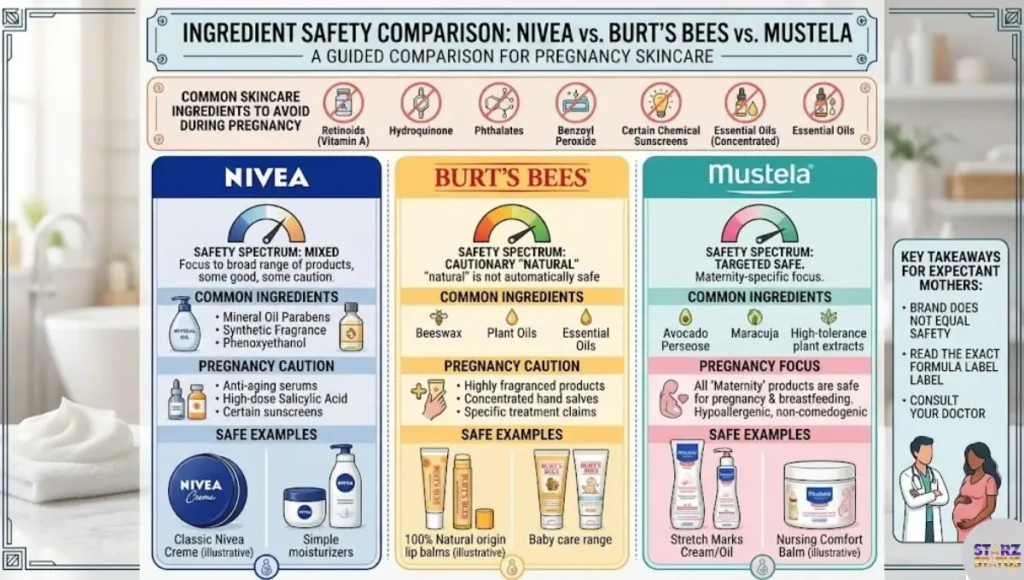
| Safety Factor | Nivea | Burt’s Bees | Mustela |
| Best for basic hydration | Good | Good | Good |
| Natural-positioned formulas | Limited | Strong | Moderate |
| Pregnancy-focused products | Limited | Limited | Strong |
| Fragrance-free options | Product-dependent | Product-dependent | Product-dependent |
| The best choice depends on | Exact formula | Essential oils/fragrance | Exact pregnancy product |
This table shows why the safest brand cannot be chosen by name alone.
Nivea may be excellent for simple hydration. Burt’s Bees may be appealing for natural-style body care. Mustela may be the most pregnancy-specific. But the better product is the one with the gentlest ingredient list for your skin.
Ingredients to Avoid or Use Carefully During Pregnancy
Retinoids and Retinol
Avoid retinoids and retinol during pregnancy unless your healthcare provider gives specific guidance.
AAD guidance lists retinoids, including prescription tretinoin and over-the-counter retinol or adapalene products, among ingredients to avoid during pregnancy. MotherToBaby also notes that avoiding topical tretinoin during pregnancy may be the safest approach, even though absorption is generally lower than that of oral retinoids.
Hydroquinone and Strong Skin-Lightening Ingredients
Hydroquinone should be avoided unless a doctor specifically recommends it.
Melasma is common in pregnancy, but strong whitening products are not the best first step. Use sunscreen, gentle antioxidants if approved, and medical guidance.
High-Strength Salicylic Acid or Strong Exfoliating Acids
Low-level exfoliation may be tolerated by some people, but high-strength salicylic acid, peels, and aggressive acid treatments should be used carefully.
AAD advises discussing high-dose salicylic acid above 2% with a dermatologist and limiting use during pregnancy.
Strong Essential Oils and Heavy Fragrance
Fragrance is not automatically dangerous, but it can be irritating.
Pregnancy can make the skin and sense of smell more reactive. If your skin burns, itches, or develops a rash, choose fragrance-free products and stop experimenting.
Harsh Peels or Acne Treatments Without Doctor Approval
Do not self-treat severe acne, melasma, itching, or rashes with strong products.
Some acne medications and prescription skincare ingredients need medical review during pregnancy. Discuss active treatments with your obstetrician, dermatologist, or healthcare provider.
Pregnancy Ingredient Safety Checklist
| Ingredient or Product Type | Pregnancy Approach | Why It Matters |
| Retinol/retinoids | Avoid unless prescribed | Listed by dermatology guidance as pregnancy-avoid ingredients |
| Hydroquinone | Avoid unless doctor-approved | Strong skin-lightening ingredient |
| High-dose salicylic acid | Use carefully with guidance | Higher strengths may be too aggressive |
| Strong peels | Avoid self-use | Increased irritation risk |
| Heavy fragrance | Use carefully | May irritate sensitive pregnancy skin |
| Essential oils | Use carefully | Some may trigger irritation or require caution |
| Glycerin | Generally useful | Supports hydration |
| Panthenol | Generally useful | Helps comfort and barrier support |
| Shea butter | Generally useful | Rich emollient for dryness |
| Mineral sunscreen | Often preferred | Helps with melasma and UV protection |
Which Brand Should You Choose During Pregnancy?
Choose Nivea If You Want Affordable Basic Moisturizing
Choose Nivea if your main concern is dry skin and you want a budget-friendly pregnancy-safe moisturizer option.
Best choice: simple, fragrance-free, sensitive-skin body lotion.
Choose Burt’s Bees If You Prefer Natural-Style Skincare
Choose Burt’s Bees if you prefer natural-positioned products and rich body moisturizers.
Best choice: fragrance-free Mama Belly Butter or simple formulas without strong essential oils.
Choose Mustela If You Want Pregnancy-Specialized Body Care
Choose Mustela if you want maternity-focused body care for the belly, hips, thighs, and breasts.
Best choice: fragrance-free stretch mark cream or maternity body care.
Choose Fragrance-Free Options If Your Skin Feels Sensitive
If your skin feels reactive, fragrance-free is usually the smartest starting point.
This applies to all three brands.
Decision-Making Comparison Chart
| Your Situation | Best Direction |
| “I just need daily body lotion.” | Nivea fragrance-free or other simple moisturizer |
| “I want natural-style belly care.” | Burt’s Bees Mama Belly Butter |
| “I want pregnancy-specific stretch mark care.” | Mustela maternity stretch mark cream |
| “My skin burns easily now.” | Fragrance-free, minimal-ingredient moisturizer |
| “I have acne or melasma.” | Ask a dermatologist before active treatment |
| “I am unsure about ingredients.” | Bring the product label to your healthcare provider |
MamaSkin Safety Check: How to Pick the Right Product
- Read the active ingredients first.
Check for retinol, retinoids, hydroquinone, strong acids, acne medications, or whitening agents. - Avoid strong anti-aging and whitening claims.
These products are more likely to contain ingredients that need pregnancy review. - Prefer gentle moisturizers and barrier support.
Look for glycerin, panthenol, shea butter, ceramides, dimethicone, petrolatum, or mineral oil. - Patch test before daily use.
Apply a small amount to one area for 24–48 hours before using it widely. - Ask your doctor for acne, melasma, or rash treatments.
Do not guess with prescription-strength or active skincare during pregnancy.
Dermatologist-Style Advice for Pregnant Women
Keep Your Routine Simple
A safe beauty routine pregnancy plan does not need ten steps.
A gentle cleanser, moisturizer, sunscreen, and targeted doctor-approved treatment are usually enough.
Focus on Hydration and Skin Barrier Protection
Skin barrier protection is especially important if your skin feels tight, itchy, or easily irritated.
Use moisturizers after bathing, while the skin is slightly damp. This helps reduce water loss and improves comfort.
Avoid Experimenting With Strong Actives
Pregnancy is not the best time to start strong exfoliating acids, retinol, aggressive acne systems, or brightening peels.
If you already use active skincare, review it with your healthcare provider.
See a Doctor for Severe Acne, Itching, or Pigmentation
Severe itching, sudden rash, painful acne, or rapidly worsening pigmentation should be medically assessed.
Some pregnancy-related skin conditions require proper diagnosis, not just a new lotion.
Expert tip: When in doubt, choose boring skincare. Fragrance-free, moisturizing, barrier-supporting products are often better than trendy formulas during pregnancy.
Common Myths About Pregnancy Skincare
| Myth | Fact |
| Natural products are always safer. | Natural ingredients can still irritate skin or cause allergic reactions. |
| All chemical ingredients are dangerous. | Water, glycerin, panthenol, and niacinamide are chemicals too. |
| Baby products are always better for pregnant women. | Baby products may be gentle, but they may not treat adult acne, melasma, or dryness effectively. |
| Expensive pregnancy products are automatically better. | A simple, affordable moisturizer may work well if the formula is gentle. |
| Stretch mark creams can fully prevent stretch marks. | They may improve comfort and hydration, but genetics and skin stretching also matter. |
| Dermatologist-tested means pregnancy-approved. | It does not replace checking ingredients or asking your doctor. |
Final Verdict: Is Nivea Safer Than Burt’s Bees or Mustela?
So, I’m a pregnant woman: Are Nivea Products Safe Compared to Burt’s Bees or Mustela? In general, Nivea is not automatically safer or riskier than Burt’s Bees or Mustela. The safest choice depends on the exact formula, your skin sensitivity, and whether the product contains pregnancy-caution ingredients.
Choose Nivea for affordable basic moisturizing, especially fragrance-free sensitive-skin lotions.
Choose Burt’s Bees if you prefer natural-style body care, but check for essential oils, fragrance, and allergens.
Choose Mustela if you want pregnancy-specialized body care, especially stretch mark and belly products.
Most importantly, do not rely only on brand names. Read the label, keep your routine simple, patch test new products, and consult your healthcare provider for personal medical advice, especially if you use acne treatment, melasma products, retinoids, prescription creams, or products on irritated skin.
Frequently Asked Questions
Are Nivea products safe during pregnancy?
Many basic Nivea moisturizers may be suitable during pregnancy, but safety depends on the exact ingredient list and your skin sensitivity.
Can pregnant women use Nivea body lotion daily?
Yes, many pregnant women can use simple Nivea body lotion daily, especially fragrance-free formulas without retinoids or strong actives.
Is Mustela better than Nivea during pregnancy?
Mustela is more pregnancy-focused, but Nivea may be fine for basic hydration if the formula is gentle and appropriate.
Is Burt’s Bees safer than Nivea?
Not automatically. Burt’s Bees has natural-positioned formulas, but essential oils, fragrance, or allergens can still irritate pregnancy-sensitive skin.
Which brand is best for pregnancy stretch marks?
Mustela and Burt’s Bees offer pregnancy belly products, but creams mainly support hydration, comfort, and skin elasticity.
Are fragrance-free products better during pregnancy?
Yes, fragrance-free products are often better if pregnancy makes your skin itchy, reactive, red, or easily irritated.
What ingredients should pregnant women avoid?
Pregnant women should generally avoid retinoids, hydroquinone, harsh peels, and high-strength acne treatments unless medically approved.
Is retinol safe during pregnancy?
No, retinol is generally avoided during pregnancy because retinoids are pregnancy-caution ingredients requiring medical guidance.

Welcome to StarzStatus.com! I’m Abdul Mannan Haider, a digital journalist and entertainment researcher with over 5 years of experience in celebrity journalism. I specialize in breaking down complex pop culture trends, celebrity net worths, and biographies into engaging, verified, and easy-to-read stories.